Saturday, April 14, 2012

Sinhala New Year Customs & Games

Everything is done at an auspicious time!!!!

                  15-04-2012
Applying oil "Hisa Thel Gama"

Daynews (2005)
This is a very special day for all Sinhalese and Tamils where their main objective is to get more life as the statement called "120 ta 220 k Aubo Wewa!!". It is advisable to anoint the juice of nuga leaves on the head at 7.08A.M. on 15th of April 2012 while standing on karanda leaves, with nuga leaves hanging over one's head. The person being annointed with oil should be facing the East, while the recommended colour of dress is in gold color. 

This very valuable activity is mostly doing in Buddhist Temples like Kaluthara Bodhi, Bellanvila, Dalada Maligawa and others where there is small village temples by a thera. The above places are famous for applying oil. If not in villages the oldest person is applying oil to the head of all who are coming at that time as figure represent in the right side. Author went to the village temple for this enviable task.

14-04-2012
Games Associated with Sinhala & Tamil New Year
The sinhala & tamil new year is looking forward about the happy and participation while sharing the expressions with each other but specially with the children because of the fun and games associated with their life. There are many traditional games people play during the festive season and more often than not they start before the dawn of the new year and continues till long after. 
The sound of crackers,nila,ahasgundu as well as the raban and joyous laughter , especially of children mingles with the melodious call of the koel during the season.

Like all the age-old rituals connected with the New Year there are also traditional games played at the "Avurudu Ulela". Some of them are very different than the games we play at other times  and at this season Sinhalese are saying good bye to cricket, netball, footballPancha keliya, onchili pedeema, kalagedi sellama, olinda keliya and porapol geheema, mallawa pora, ali pora, gon pora, lanupora addima, rilapeti pedima, dadu gasimaare some of the games played during the New Year. These games bring fun and joy to our lives and at the same time, teach us a valuable lesson about team spirit too. 

1. Pancha Keiya
This is a very popular game among Sinhaleese. Pancha is played with five small seashells, a coconut shell, and a chart. Players are divided into two groups. 
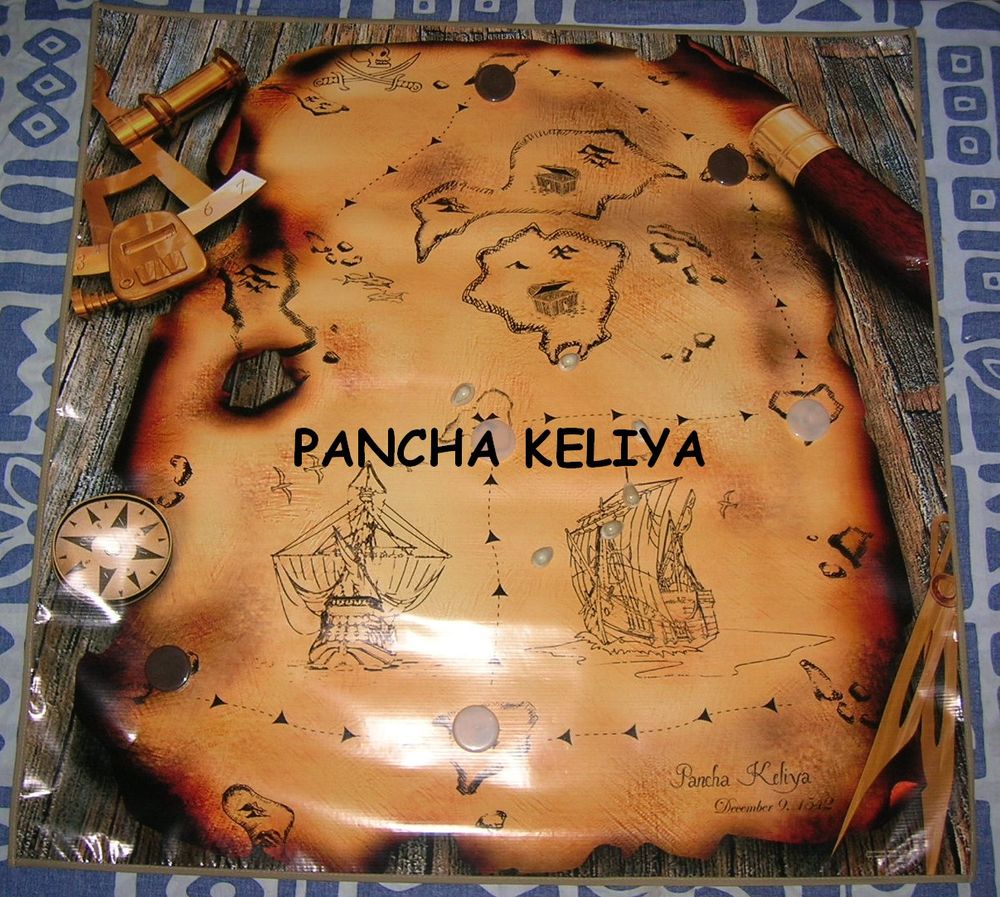
Associationklz.sitew (2012)
Daynews (2005)

2. Onchili pedeema
Author (2007)
This is famous among the the women/ girls where the swing is tied on a strong branch of a tree in the gardenSometimes when swinging, there are two on the swing and one on the ground pushing the swing and they sing special verses known as onchili waram, which are known as ‘varang kavi .

According to Infolanka (2012), the kathru onchilla (great wheel) was introduced by the foreigners. This wheel like structure was put into motion going round and round by a person who actually walked in step inside the wheel to turn it round anti clockwise. This  can be see in villages. But some get frightened to go in this kathru onchillava.

3. Kanamutti bideema
Author (2012)
This can be seen in the Avrudu Ulela. The person who hits to the pot is closing the eyes by a cloth and there are few pots hanging on a rob. In one pot there is special something like flowers, colour water etc. If the participant hit to the correct pot he/she will be the winner.

4. Puting the eye to the elephant
This is a very joyful activity where small ones like to put the eye on a image of an elephant. Most of them are putting it on the tail or stomach but at last a one will be able to put the eye at the correct place. 
Author (2012)
  

5. Olida Keliya
"Olinda thibenne koi koi dese,
Olinda thibennebangali dese.......
Genth handanne koi koi dese,
Genth handanne sinhala dese..." 
Sundaytimes (2011)
Olinda Keliya is know as Mancala game uses a wooden board (olinda kolombuwa/poruwa) which has several holes. Normally played by 2 players where 9 holes are placed 4 beads each.Olinda seed's sting behind bright red and black.Players shift the beads from a hole to the other and collect seeds found in the hole quickly after an empty one. When the most seeds collected person becomes the winner of this game.

16-04-2012
Author (2010)
6. Climbing the greased pole
This can be done after having a Nestomolte/ Laogi tea as this is very interesting and hard activity. But at the end there will be a winner who picks the flag from that grased pole. Some avrudu ulelas are doing this individually/ grouply. 

7. 
Beating the rabana
"Dontha babakkata denna deyakna
Pettagamak uda thutu dekak atha"
The bench rabana which is used for raban playing is a large one, which is supported on 4 wooden legs about a foot in height. The players, mainly woman, about 4 in number, sit around the rabana and play in unison, using their hands, as well as the head etc to make interest among the audience. Very often the players sing raban pada which indicate the beat that has to be played.This is taken place in each and every raban competition. There are   men too who take part in this by playing the drums. The drum is heated before the session begins,so that it will give a melodious tone when beaten.There were women and men who have been taken part in this activity in the 2012 Sooryamangalya in Kaluthara. And also the small children are willing to play the rabana to different raban pada. 

8. Balloon
Author (2008)
This is common to the children age between 8- 12 years. This is bringing interest to the audience and in the noon this is bring the winners easily.


9. Bun
The bun are hanging on a thread where the participants have to eat them without touching from there hands. Its little bit danger with the teeth too. 
Author (2008)


10. Bicycle
This is held for both parties female and male which is mostly sponsored by DSI for the sooryamangalya with the bicycles/ Tyre. And partisipants are given a particular millage where they have to cover the area by riding the bicycle. 
Author (2011)
11.Porapol geheema
This involves two teams, each taking turns to throw a coconut until all the nuts on one side are broken. The winning nut will be kept in the temple. This game is very famous in the southern part of the country, especially in Matara and Devundara. During ancient times, only king coconuts were used, but nowadays with the demand and price of the king coconuts,the coconuts are used. The popular belief is that the origin of this game dates beyond the advent as a gift from the Buddhism.
Sundayobserver (2011)
Hook Tagging (Angkeliya) and Coconut Striking (Pora Pol) are two games that have religious overtones. These are starting with the blessings of Goddess Pattini and usually held when infectious diseases are around or when there is a longer drought in the area. The village is divided into two sections along a water way/some natural boundary and naming the 2 teams as ‘Yati Pila’ and ‘Udu Pila’. In Pora Pol two types of coconuts are needed one in the shape of a Rugger ball and having a very hard shell, the other a normal round one. A coconut is thrown at a contestant in the opposite side. The ultimate winning side is the one that has least number of chipped nuts.
Ang Keliya is ritualistic game to invoke the blessings of Goddess Pattini. The origin of this was a tussle between Pattini and Palanga, when they were plucking Sapu flowers. The two hooks got entangled and when they tugged, Palanga’s hook gave way and Pattini won.
Gudu Keliya is another game played mostly by the smaller children. A propelling stick about two and a half feet long and a smaller one about six inches in length called the kuttiya are used.These games go on for 7 days at the end of which there is a Gam Maduwa (a ritual dance performance) and an alms giving on the next day which the whole village partakes, without any sort of class or creed distinction. In the evening there is further dancing and sometimes even fire walking.

Many new items such as Beauty Queen Contests, Fancy dress competitions, pillow fighting, various kinds of races such as bicycle, lime and spoon, sack, three legged etc are included. To give the festivities a national flavor and also to attract adults, competitions in coconut scraping, weaving of coconut fronds, reciting verses etc. have also been added.

According to author, throughout the Sinhala and Tamil New Year when the performance of various activities connected with auspicious times have been successfully concluded, it is time for festivities and games. What is special here is that very frequently, the whole family joins in. Under normal conditions, during the year, the parents have no time to join their children, playing games. The father is at job, so is the mother, if not outside the house, at least within it, attending to the various household responsibilities. But New Year changes this pattern.
And so, most of the Sinhalese and Tamils must be eagerly counting the days to the dawn of the Sinhala and Tamil New Year as it is one of the many festivals which brings fun for everybody to enjoy themselves by playing the  games while tasting the mouth with traditional sweet meats. 

                                                SWEET wishes 
                                         for a SWEET person 
                                                  from a SWEET living being.....
                                         for a SWEET motive
                                                   at a SWEET instance
                                         on a SWEET day 
                                                   in a SWEET year........
                                  Have a SWEET Sinhala and Tamil new year...................

Thursday, April 12, 2012

Sinhala & Tamil New year

Let's celebrate the Sinhala & Hindu New Year


Preparation for the Sinhala and Tamil New Year
Author (2012)
From this week on wards Sinhalese and Tamils  get ready to by new clothes, pots and pans, and many other things. And also they are are cleaning the houses by removing the cob webs. Then color wash the houses to make the house fresh and look nice. And prepare the Kokis and Munkavum (traditional Sri Lankan sweet meats known as “Rasa Kawili”) during the frying more nibbling takes place than anything else.This happens as specially with Kokis, as if we don’t do this properly it gets into all funny shapes!!!  


Author is also busy cleaning the house ad busy with the preparation of the new year. And also helping to make sweet meats as shown in the below diagram. 

Author (2012)
The astrologers worked out Nekath (auspicious times) to perform the rituals in order to bring about prosperity and happiness to the people and country. The dawn of Aluth Avurudda signifies social customs and good behaviour of the Sinhala people. The majority of people are farmers, after the major harvest "Maha" of the year is over, celebrate the occasion by offering thanks. The customs and rituals represents the beliefs and thinking of the people whose life is centered around agriculture.
Viewing the moon for Soorya warsha was held on 22nd April 2012. Today (12th of April 2012), rituals are connected with Aluth Avurudda commence with bathing on the last day of the old year. In the village temple, the pealing of the bell accompanied with the beating of drums (Hewisi) make the people aware of the times to perform different rituals. 


Author (2012)
A type of cuckoo bird, has a strong relaion with the new year celebrations in traditional literature around this festival. The mating season of this bird roughly coincides with the festival season. This bird is known as the Koha in Sri Lanka by the Sinhala language. The melodious sound "Koo-ooo" of the bird is heard throughout Sri Lanka during this season from March to end of the new year.


Authour (2012)
And also the red flowers which is known as erabadu is bringing a nice reddish environment which is attractive for everybody. This is another sign which is representing the Sinhala New Year.  


Author (2012)
Kaju Puhulam is fading as a symbol of the Avrudu. The ripe red, orange, yellow cashew fruits nicely bundled together during this season. There is a traditional game called "Vala Kaju Gaseema". A small hollow is made in the sand and a player has to try to put his cashews in it or hit others afterwards. But now these are disappearing from the young generation. Even in our village side this is very popular. 


Both communities use the Sinhala and Tamil New Year season to refresh and re-dedicate the cultural  obligations to many centuries of unbroken customs based on social ethics. New Year season is a period that provides opportunity to erase off petty differences and misunderstandings among relatives and friends and renew their mutual affection.
The Sinhala and Hindu New Year day is a great day not only to Sri Lankans living in Sri Lanka but also to those of Sri Lankan origin living in the rest of the world. They too celebrate the New Year day to renew their allegiance to values of the cultural heritage, despite their presence in multicultural mainstreams. 

Maharishiyagya (2012)
Occasion of the dawn of the Sinhala and Hindu New Year is an extremely significant event for Sinhalese (by race) and Hindu’s (by religion) in Sri Lanka. When the Sun transits from Meena Rashi to Mesha Rashi in the celestial sphere, Sinhalese and Tamils celebrate the dawn of the Sinhala and Hindu New year. The transition time know as "Sanskranthi" takes place on April 12 or 13.


13-04-2012
Nonagathaya/ Punyakalaya


Astrologers have said that beginning of the new year and the conclusion of the old year is special for Sinhalese and Tamils.The customary beginning and ending of new year, there is a period of a few hours in between the conclusion of the Old Year and the commencement of the New Year , which is called the nonagathe / punyakalaya (neutral period). On 13th of April 2012, the Nonagathe is staring from 12.56P.M. and till 1.44A.M. 14th of April 2012During this time people keep off from all types of work and engage in religious activities. However, during this period they refrain from doing other activities such as cooking, eating and studying. 

Dawn of the Sinhala and Tamil New Year

The New Year is heralded by the constant lighting of fire crackers and the the good news of cuckoo bird at 7.20P.M. on the 13th April 2012 and this is the dawn of Sinhala and Tamil New Year.
                                             
                 " Me Labana Wu
                    Sinhala Alut Awurudha 
!!!!!!!!!!!!!!!                                                                

                                  Kiriyen!!!!
                                  Paniyen.......
                                  Sathutin Piri.....

                                              Karadara
                                              Neti.....

                                                           Adaren!!!!
                                                           Samayen.....
                                                           Karunawen 
                                                           Piri.......

Subame Subame Subame Suba Aluth Wewa Oba Sameteaa!!!!!!!!!!!!!!!!!!!! "


Sinhala and Tamil New Year Traditional Customs


Fresh pots and pans now awaiting the preparation of the first meal of the new year.The woman of the house lights the hearth at the auspicious time which is holding at 7.42P.Mand prepares the first meal of the New Year. 


This meal is eaten at the auspicious time given to partake the meal at 10.28P.M. At 10.28P.M the rituals of commencement of work and the first transaction are also performed.


Author (2012)


Author (2012)


The goddess of Chastity, Paththini Deviyo is the main figure among the people of Horana. In areas such as Kalutara and Ratnapura most of the rituals were also connected with the Paththini deity. There was a person named Paththini hami in these villages. He was one of the farmers in that area, who owned the Devala and jewellery from the goddess known as Paththini Salamba. Just before the Sinhala and Hindu New Year, Paththini hami paid a visit to every household to collect the first portion from their harvest. This portion was known as Pin Vee. Then he offered this share to the goddess. 


At 10.28P.M. chief female occupant of the house dropped a coin wrapped in a piece of clean cloth into the well and filled a bottle from the first bucket drawn from the well.Then this bottle was kept in a highest place of the house and the level of water in the bottle was monitored throughout the year. It was believed the level of water indicates the prosperity of the house. "If the water level has gone down, it was believed to be a sign of a bad period the family suffered." "During the first few months after the dawn of the New Year, housewives checked this bottle from time to time to get an idea about the good and the bad periods of their family. It gave them some kind of a satisfaction." again. 

As a custom of the Sinhala New Year the younger people worship the elders with a sheaf of beetle leaves and then the elders give them some moneyAt this time, they are given a coin to offer to god and some money for their use, Hindu's call this ritual Kai Vishesham,which is exchanging money between the family members. But in the present this ritual is going down. However, in the past the elders worship all the below ages people by a day and getting the wishes from them. Among the Sinhalese in the villages this is very popular and this represents the real Sinhala Buddhist in the country at the New Year. But this should be there for all the days of the life. 

Author (2012)
                         
                                        Suba Aluth Awuruddak Wewa !!!
                                        Samaya Sathuta piri
                                        Siyalu pathum ituwana
                                       Suba Aluth Awuruddak Wewa !!!                    

Wednesday, April 11, 2012

Active Learning Vs Passive Learning

Active Learning
According to 1.umn (2008), An umbrella that refers to ultimate responsibility for learning rests with the students, good teaching encourages to put forth more effort, gives opportunities for practice, and provides feedback on performance is known as  active learning. Cooperative learning, problem-based learning, and use of case methods and simulations are some approaches that promote active learning characteristics (District287, 2012). Active learning requires the students to take liability for learning, not just the teacher. The challenge of active learning is to expect the generalization performance of a learning machine before training data is gathered. 
Edutor (2011)

There are many ways to achieve active learning in the classroom. Within the class the teacher selects suitable active learning strategies which takes few minutes to cover the activities/ the entire class period, and involve the students as individuals/ in groups. The learning strategies selected will be determined by :
  • teaching style of the teacher
  • specific discipline
  • course level
  • experience and knowledge of the students
  • preparation time of the teacher
  • objectives of the teacher                                                                                (District287, 2012)
Value of Active Learning to the Students
According to fctl.ucff (2012), most important value is that active learning increases students' retention and comprehension of the course material because of the tasks to be accomplished become clear, utilizes the students knowledge, students have an opportunity to provide personal insights to develop their own answers, allow students to experiment with ideas, to develop and integrate concepts into larger systems. Active learning develops social experiences between students and between teacher and students too. It can build students and teacher within the classroom.
Value of Active Learning to the Teacher
Active learning concentrates on teaching function which helps teacher to select objectives at the correct level of student needs in order to meet them correctly (fctl.ucff , 2012). The teacher encourages students to be responsible for their own learning.
Risks of Trying Active Learning Strategies in the Classroom
Teachers give up the role where they act as an expert, group leader. Many teachers, giving up authority and control of the teaching in the current society  (District287, 2012). When the author attend school also teachers give up the responsibility of teaching to the students because that the students are responsible for active learning.
Getting started with Active Learning
  • Low risk but highly effective is the modified lecture.
This technique will enhance student retention and comprehension. Students work in pairs to discuss and  to answer a question or solve a problem. Since each person in the class encourages participation, active learning is promoted (Bonwell, 1991)
Ite (2004)

Techniques of active learning

- For Individuals
These are not interrupting the flow of the class as its easy for individuals. These are useful to provide the instructor with feedback concerning student understanding and retention of the task. 
  1. The One Minute Paper- A highly effective technique for checking student progress in understanding,  reacting to course material by giving  few questions which is  needed to be answer with one/ two minites.
     
  2. Clearest Point - Students are provided some questions with a little longer time period to answer.
     
  3. Affective Response -Teacher is asking students to report their reactions to some aspects of the course material. This is limited to the subject areas which is useful at starting point for courses.
     
  4. Daily Journal - Allows for more in-depth discussion of or reaction to course material. Only disadvantage to this approach is that the feedback will not be give at once. as it's assigned for homework.
     
  5. Response to a teacher centered activity - The students are asked to write a paragraph that begins with: I was surprised that ... I learned that ... I wonder about ... This allows the students to reflect on what they actually got out of the teachers’ presentation.                                                  
(Calstatela, 2012)
Allsaintshayward (2012)
Techniques of active learning
  1. The One Minute Paper- A highly effective technique for checking student progress in understanding,  reacting to course material by giving  few questions which is  needed to be answer with one/ two minites.   
  2. Clearest Point - Students are provided some questions with a little longer time period to answer.  
  3. Affective Response -Teacher is asking students to report their reactions to some aspects of the course material. This is limited to the subject areas which is useful at starting point for courses. 
  4. Daily Journal - Allows for more in-depth discussion of or reaction to course material. Only disadvantage to this approach is that the feedback will not be give at once. as it's assigned for homework. 
  5. Response to a teacher centered activity - The students are asked to write a paragraph that begins with: I was surprised that ... I learned that ... I wonder about ... This allows the students to reflect on what they actually got out of the teachers’ presentation.      
  6. Collaborative listing and ranking -  A group process by which members determine the individual aspects and prioritize them in a hierarchical order.   
  7. Role-playing - The instructor provides imaginary contexts along with roles. students are encouraged to research on those contexts and dramatically present to the during class period. 
  8. Debate - A formal discussion in which an issue or topic is approached from two, completely opposite points of view.  
                                                                                  (Indiana , 2012 and Calstatela, 2012)


The above techniques are used by most of the lecturers in APIIT, to build interest in the lecture to the students as students are responsible for active learning. So that students gets the exact idea of the topic and understand the work. Even the lecturer gives homework to do the students will do it in an interesting manner.                                           


Passive Learning
Students will enter the course which they want to study with open minds, which are like empty vessels and the teachers will fill the minds of the students with knowledge, simply for the sake of securing better results in the examination (Blurtit, 2012)This concept is taking place in the traditional classes which mainly focus on the role of the instructor in the classroom. (Think that the students have the same level of knowledge as the teacher.)
Finally after each session the students usually remember only about 10% of the content which was taught during the class session. The lecturer in passive learning is basically a verbal textbook whose lectures are usually dull.(Blurtit, 2012)
Burcuakyol (2009)
According to authors opinion, today, in the school and in universities most of the students are passive learning as if the student raise the question the instructor/ lecturer is blaming. Passive learning is boring than the active learning which is elaborating in the below section of the topic. In some lectures students are listening and lecturer is teaching standing in front of the class without making humor. So that students are bored and dull.When  the lecturer give homework the students cannot understand the aspects taught in the lecture and the students are giving the work to do to another guy. This is specially happening in each and every batch of the school and universities. So that the teachers should be responsible for the future of the students life.....
Edutor (2011)
Difference Between Passive And Active Learning?
According to Blurtit (2012), Passive learning is the traditional lecture approach where students sit in the seats listening to a person standing at the front talking about something. Where as an Active learning involves students mentally, physically in learning the content because engagement improves their ability to remember and understand content (Blurtit, 2012)

Monday, April 9, 2012

Combining work ad study effectively

Effective management of work-based projects 
Most of the academic aspects are work based projects and use variety of skills. Before understanding the work-based project, check whether you need employer's agreement. If the project need to conduct an informal  observation or experience no need to get the permission from the employer (Cottrell
 ,2008). If is in other way around means that if you are using the employer's working time and resources for the projects, using the official documents of the particular company you need to get the permission from the employer (Cottrell,2012).
Project-management-templates.lastdownload (2011)
Organize yourself for the project
  • Check legal data protection and how you will meet these
  • Gain permission for use of workplace data
  • Think whether you are needed to use the workplace materials, photos etc.
  • Schedule the time for conducting interviews or observations and remind them before you go to meet them on the right day. 
Workplace support team
If there is a support team that's easy to negotiate access to data, relevant work tasks, study time or other resources, know the pressure of the work of  the student,  can provide current professional and practical perspectives on issues.
Us.123rf (2012)
How to get use of Workplace support team
  • Build the relationship with the  support team and be friendly with them
  • Clarify what you need from the support team and check are they able to provide these information
  • Arrange times for the meeting or observations by talking to the support team
  • Arrive prepared for the sessions 
According to author effective management of projects need the following skills
  1. Team work skills in order to work with others in  group.
  2. Research skills before go to a particular workplace to collect information.
  3. Managing the time for the best days plan for the interviews etc.
  4. Prepare a note what you need from th work place.
10-04-2012
Effective management of study-release time 
Employers may offer study-released time at work.If you can manage this its extremely valuable.
  • I prefer taking a whole study day once a fortnight rather than a half day each week.
Half day release can be more difficult to manage effectively. It means afternoon is wasted for travel, provide less opportunity for study. This tends to suit the people who prefer short time bouts of study, little travel to undertake, manage time for study well. 
Effective-time-management-strategies (2012)
Making best use of time for study
  • Plan ahead at least for a week so that you make most of the time available. So that by identifying the activities which is being needed to be complete in the week helps to achieve success.
  • Check whether there is a quite room for the work with your favor of the situation. 
  • If you have negotiated the study time in the workplace, see whether you can connect to online study resources from there.
  • If you find it better to use the release time for non-study purposes by planning that time effectively. 
CREAM strategy for learning
* C- Creative 
Have the confidence to use individual strategies, applying imagination to learning. (Cottrell, 2008, P55)
* R- Reflective
Able to sit with the own experience, analyze and evaluate the performance and draw lesson from it. (kcl.ac, 2007)
*E- Effective
Organize space, time, resources to maximize the benefits.(kcl.ac, 2007)
*A- Active
Personally involved in doing things physically and mentally.(kcl.ac, 2007)
*M- Motivated
Aware of own desired outcomes keep track in short and long term goals.(Cottrell, 2008,P55)

Saturday, April 7, 2012

Build teams with time

Effective Diary keeping


A ‘week to view’ diary for the academic year is perfect. Fill in the important dates for the year for family holidays, medical appointments and study activities.
Nwpf (2012)

Development and running of a successful life often comes down to being in control and across all issues be appropriate to the day to day procedures. From Don Matlock ‘s experience (Evancarmichael, 2012), an important part of achieving success in life was make use of the effective use of a detailed diary, allowing him to have confidence within himself in relation to timing.

What to put in about students study?
According to Cottrell (2008,P71), to be effective, diary needs to be a complete record of what student have to do:
  • Write in all study deadlines, exam dates, field trips, etc.
  • Write in exactly where and with whom each appointment or lecture is.
  • Schedule some free time to be used in catching up on what got missed.
Mapping the time patterns suite to a person based on:
  • Think about the subject.
  • Prepare for lectures and seminars.
  • Prepare for other formal sessions.
  • Plan own work.
  • Organise and refile own notes.
  • Reflect on own learning.
  • Discuess work with others.
  • Research each subject.
  • Write early drafts.
  • Edit and redraft your writing.
  • Check own work.                                                                                                    
                                                                                         Cookiedoughlove91.blogspot (2010)
The above points, author map to own life and it looks as follows. 
First of all, author thinks about the subjects which has lot of content as well as hard. Then plan the lecture hours and group discussions for the particular subject. Next if there are some own activities plan them too. Next maintains the own notes about them. But author can edit those or check in any time. And also think about the preferred time of the day and schedule the activities. Author use the early in the morning for studying hardest subject contents. But the day is starting bit productive in the morning and at night it carries to the highest productivity. Some are more productive in the morning and less productive at night. And few are less productive in morning and night where as the mid day is high productive. (Cookiedoughlove91.blogspot, 2010)

08-04-2012
The strength of the team is each individual member... the strength of each member is the team

Lecturer Mr. Rehan started talking about Team Work which was very interesting for everybody. Before starting the lesson lecturer asked Waheed to select people who he like by him and he chose Chalitha and Madara. Then those 3 fellows were asked to come to the front of the class and Chalitha was asked to get on to a chair and fall backward where Waheed and Madara were supposed to catch him (Chalitha). As Chalitha is a tall person the whole class got anxious to see whether Chalitha would do that. But  group members declined it as they weren't ready to take this risk at now. Main reason of this activity was to show that trust  is essential when group of people are working together. 

Afterward the lecturer asked Siddeek and Chalitha to select their group members and build up a ladder using chairs where a group member should be able to climb up. After making two different ladders by the groups,finally with the help of all team members build up the first strongest ladder with four steps where Natasha was able to climb up.  The other group also built their ladder secondly which was higher than the wining group of 
Siddeek. Natasha climbed to the ladder and showed the winning post where as Ashiky from the other group climb to their ladder afterwards. Asiky was frightend to climb to the last part of the ladder where there was only one chair powered by Ahmadh. But finally Ashiky gained the challenge from Ahmadh and climbed to that too.Actually this was interesting all of us.

Everybody were happy and Mr. Rehan said that he had a risk until the students finish this task securely. Next explained the IPLE concept of a team work which is described below.
  I – Individual
  P – Planning
  L – Leading
  E – Empathy