Monday, November 5, 2012

Introduction to Applied Research Methods & Professional Development

We started our session with the Lecturer, Mr Syed Rehan, giving a brief introduction of the Module which is 
Applied Research Methods & Professional Development.
 The lecturer informed us the 
  • Learning Objectives
  • Module Aims
  • Module Learning Outcomes
  • Topics covered during the semester
  • Essential books which have to be read.
Mr Rehan further went on to teach the skills and careers in IT. As the skills the main 4 skills below were highlighted.
  • Ability to understand the problem - Problem Analysis
  • Ability to apply the suitable solution - Academic Research
  • Ability to design the solution - Converrt problem to software
  • Ability to implement the solution - Artifact
At the end of the day, I understood what is expected of me from the industry and where i currently stand and how i could enhance my professional skills in order to match the power of the industry.

And also discussed about the Final Year Project Proposal, Portfolio as well.

Final Year Project Proposal
  1. Problem Background & Problem Analysis
  2. Problem Statement (Research Question) 
  3. Literature Review
  4. Research Methodology
  5. Research Plan
  6. Risk Management
Portfolio (Learning Log) & CV
  1. What was discussed daily in class?
  2. Analysis
  3. Independent Learning
Each Log MAX pages is 3 for a week.

At the end of the day, I understood what is expected from me in the Final Year Project and in this module how i need to perform in order to gain a best grade.And some of the above mentioned components in Final Year Project will be covering in this Second Year.

Sunday, November 4, 2012

Danger and Destruction of Floods and Hurricanes


 Floods and hurricanes have been affecting the lives of people around the world for years. A flood is an overflow of water on dry land. The two types of floods are coastal and river floods.

A coastal flood is the flooding of beaches and surrounding areas; together with bar spits and deltas. They can be affected by tidal waves and coastal currents. Coastal floods can wrap a large amount of distance along a coast. The length of time a coastal flood is dangerous is usually very short. It depends on how high the tide is which goes up and down twice a day. When the speeds of hurricane winds become severe the height of the waves become three or more feet higher than the previous high tide.

Coastal floods can be caused by a number of things. Coastal floods can be caused by runoff, hurricane waves, tsunami, and hurricane rains. Coastal flooding can not only take part on oceans but it can also take part on lakes. Coastal flooding can be a great danger because coast lines are very compactly occupied areas. Although they get smaller before reaching shore, wind generated waves have been covered to be as high as 30 m in the middle of the ocean.

River flooding can be happen numeral of ways. The causes are rain, snowmelt, and ice jams. Soil cannot absorb as much water with continues moisten. The longer that precipitation lasts the more water flows into streams as runoff. Cloudburst floods only last for a couple hours, but they need a large amount of rainfall.

Saturday, November 3, 2012

2012 Literature Month promote APIIT Students ...

September is well-known as Literature month in Sri Lanka. Literary festivals are organized Island wide throughout the month under the support of the government, universities, book publishers, printers and non-government organizations. 

The tendency of reading among youth should be improved. The current day youth prefers to read love stories rather than works of such renowned writers such as Martin Wickramasingha or K. Jayatileka. Local scholars should be encouraged to write books on science and other fields in Sinhala as there is a dearth of science writers in the country.

English books on science, maths and various other subjects are imported from India and other countries. The main theme of the literature month should be to create a reading public. Most of the libraries are not patronized specially by the youth. The lack of interest in reading is detrimental to the society. Schools should organised competitions to reward students who read. Most of the musical contests end-up in brawls and at time in killings as well.
The youth are not equipped with the facility to enjoy music or singing. Low quality Tele -dramas and novels corrupt young minds. Steps should be taken to promote reading among youth.

The powerful “Colombo International Book Fair” held in 2012 between 17th to 25th September, for the consecutive 13th time.  Under the organization of Sri Lanka Book Publishers Association this jumbo book fair apprehended annually in BMICH- Convention & Exhibition Center since 1999. In the commencement it was only 28 stalls for the exhibition. Annually due to the grown popularity number of both books publishes and visitors considerably increased. 

Also many of the Libraries as well as universities conducted many events to enhance the knowledge of subjects in reading and to build a full man with power of knowledge.


Reading provides us the possibility of opening ourselves up to a magical world, which helps us to become perfect. Histories make men wise, poets witty, the mathematics subtle, natural philosophy deep, moral grave, logic and rhetoric able to contend. So if you are considered to be lack of wisdom, history will teach you how to think and heighten your ability of analyzing and solving problems.

If you always feel yourself stay in a confused state, philosophy will illuminate the path in front of you. If you hope your life is suffused with romance and passion, read poets please. Shakespeare, Byron and Shelley will put color on your life.

In a word, books are the crystals of all intelligence. Reading not only enables us to make a conversation with all the giants, but also lets us to think profoundly by standing on their shoulders. Reading offers us a marvelous word, comfort our soul and improve our capability, and hence all these impacts together will make a full man. 

The individual reading, creative writing, filling puzzles etc competitions were conducted to enhance the students reading ability in the APIIT City Campus 2012. It was very competitive among the students and was held on 01-06 in October 2012.Because of the Students Examinations conducted in September and considering holidays of the students. The following image taken by author includes the competitions conducted in the reading week at APIIT.


Author attended to the last competition as she is a favor of that and has the experience for that competition island widely too. So author wrote an essay for the topic "Higher Education In Sri Lankan Private Universities id a Success or a Failiure" .  

Some students in APIIT participated to the competitions and I like to say that the participation to a university competition is also good than staying along by watching movies or chatting with others. Although i am going to APIIT from 2 years this is my FIRST time participated to a competition conducted by APIIT and i will never forget this valuable occasion in my life forever. 


The winners were on the notice boards of APIIT and my name also was there for the participated competition. And for all the winners there was a prize giving in the APIIT Level 3 on last 31st of October 2012. And the chief guest was Dr. Athula Pitigalaarachchi and there were some of the lecturers and library staff as well the Marketing staff. The start and the end of the prize giving was extremely good. The sponsor was by Expo-Graphics and Sarasavi Bookshops and the seating arrangement was good. The speech of Dr. Pitigalaarachchi, Ms Wathsala were good and important to the students to make a full man of reading in the future life. The students were gifted with some books and some valuable things. And I take this opportunity to thank for the all guests attended as they helped us to enhance our talents in the competitions.


Good readers can understand the individual sentences and the organizational structure of a piece of writing. They can comprehend ideas, follow arguments, and detect implications. They know most of the words in the text already, but they can also determine the meaning of many of the unfamiliar words from the context - failing this, they can use their dictionary effectively to do so. In summary, good readers can extract from the writing what is important for the particular task they are employed in. And they can do it quickly!

Why women make great leaders?

With countless different approaches to leadership, there's another variable to add to the list: Whether you're a man or woman also helps determine your management style.


Susan Spencer, author of "Briefcase Essentials," says women have a unique approach to leading in the workplace and have 12 natural leadership skills. "Women's skills are different than men's, and when they work together they have a balanced leadership that benefits the entire organization," she says.

How female leadership styles differ from those of their male counterparts, and why it's beneficial to have both types of leaders are very important to all of us.


Leading instead of commanding
Female leaders are more concerned with helping everyone feel like a necessary part of the team than with being the only ones at the helm. Women do not manage by 'command and control' as men do. They direct by embracing teamwork and building hard professional relationships with each member of the team. In a strong financially viable environment that's going through disordered times, this quality can help employees feel more connected to their workplace.

Communicating effectively
Running an organization or department often requires communication skills, something that many women have mastered. Women communicate with employees at all levels of an organization regardless of their pay grade that it contributes to a positive working environment. Having this free pour of conversations also helps maintain employees on the same page and prevents loneliness.

Acknowledging mistakes
Admitting your errors can be difficult for top managers, but it can help subordinates relate to the boss and realize that she is only human. This is another positive attribute. Women leaders are not afraid to declare their mistakes. By being straightforward and approaching about accepting responsibility where it legally belongs, they earn the trust and loyalty of their employees or organization.

Leading with compassion

One of the most important personalities of female employers is their capability to identify with their employee. Especially when a company goes through challenging, leaner times, women may more understand of their subordinates' problems, without simply dismissing them as unproductive employees. They will be highly familiar to the problems of others and can put themselves in their shoes. Using understanding to manage conflict between employees is also a key skill.

Flexibility
Another key characteristic of female leaders is flexibility when making decisions. Men think linearly and women think contextually. This means that women have the ability to consider multiple options to problem-solve and arrive at a broadly analyzed problem.
Contextual thinking results in a more thought-out process when making some company decisions and can direct to innovative solutions.

Even as some companies realize these characteristics, many women still see huge barriers when trying to accomplish the highest positions in their firm and many still cannot land the same key roles as men.

Women still get compartment into high-end administrative tasks. At some companies, women suffer from the typecast of men being natural leaders and must constantly battle this misconception. 

It's not all bad news: In the last 10 years things have changed, especially at the largest companies, where mentoring and other programs are meant to provide a network for women looking to lead organizations.


Friday, November 2, 2012

We never know the worth of water till the well is Dry

Water is the key to life: a crucial resource for humanity and the rest of the living world. Everyone needs it and not just for drinking. Our rivers, lakes, coastal and marine waters as well as our ground waters are valuable resources to protect. Society uses water to generate and sustain economic growth and prosperity, through activities such as farming, commercial fishing, energy production, manufacturing, transport and tourism.Water is important in deciding where we settle and how we use land.

Water can also be a source of political conflicts – in particular where water shortages occur. For our  own well-being, not only clean drinking water but also clean water for hygiene and sanitation is crucial. Water is also used for recreational activities such as bathing, fishing or just for enjoying the beauty of coasts, rivers and lakes in nature. We expect clean rivers and coastal waters when we go on holiday, and we expect an unlimited supply on tap for showers and baths, washing machines and dishwashers.

All water has a perfect memory and is forever trying to get back to where it was


Water is a chemical essence with the chemical formula H2O. A water fragment contains one oxygen and two hydrogen atoms connected by coalescent bonds. Water is a liquid at temperatures above 0 °C (273.15 K, 32 °F) at sea level, but it often co-exists on Earth with its solid state, ice and water vapor or steam. Water also exists in a liquid crystal state near hydrophobic surfaces.

"Don't you realize that the sea is the home of water? All water is off on a journey unless it's in the sea, and it's homesick, and bound to make its way home someday"

Water covers 71% of the Earth's surface, and is vital for all known forms of life
·         On Earth, 96.5% of the planet's water is found in oceans, 1.7% in groundwater, 1.7% in glaciers and the ice caps of Antarctica and Greenland, a small fraction in other large water bodies, and 0.001% in the air as vapor, clouds and precipitation.
·         Only 2.5% of the Earth's water is fresh water and 98.8% of that water is in ice and groundwater.
·         Less than 0.3% of all freshwater is in rivers, lakes, and the atmosphere, and an even smaller amount of the Earth's freshwater is contained within biological bodies and manufactured products.

Water on Earth moves continually through the hydro- logical cycle of evaporation and transpiration, condensation and usually reaches the sea. Evaporation and transpiration contribute to the precipitation over land.

Safe drinking water is essential to humans and other life forms. Access to safe drinking water has improved over the last decades in almost every part of the world, but just about one billion people still lack access to safe water and over 2.5 billion lack access to adequate sanitation.

There is a clear relationship between access to safe water and GDP per capital. However, some observers have estimated that by 2025 more than half of the world population will be facing water-based vulnerability. 
A November 2009 report suggests that by 2030, in some developing regions of the world, water demand will exceed supply by 50%.Water plays an important role in the world economy, as it functions as a solvent for a wide variety of chemical substances and facilitates industrial cooling and transportation. Approximately 70% of the fresh water used by humans goes to agriculture.


Thursday, November 1, 2012

Difference between E-commerce and E-Business


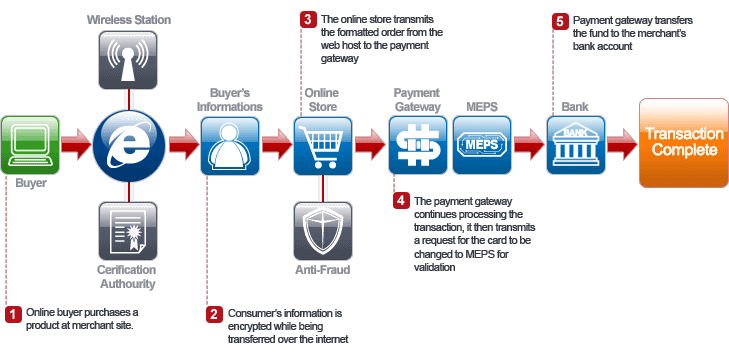
E-commerce is buying and selling using an electronic medium. It is accepting credit and payments over the net, doing banking transactions using the Internet, selling commodities or information using the World Wide Web and so on.


E-Commerce websites are specialized websites that allow financial transactions to be transacted over the internet. E-Commerce websites can be stand alone operations, or can augment physical retail operations. E-commerce websites do not necessarily have to sell products – such websites can be also be built to sell services such as subscriptions and memberships and more.


Electronic commerce, commonly known as e-commerce, is the buying and selling of product or service over electronic systems such as the Internet and other computer networks. Electronic commerce draws on such technologies as electronic funds transfer,supply chain management, Internet marketing, online transaction processing, electronic data interchange, inventory management systems, and automated data collection systems. Modern electronic commerce typically uses the World Wide Web at least at one point in the transaction's life-cycle, although it may encompass a wider range of technologies such as e-mail, mobile devices and telephones as well.


Electronic business, commonly referred to as "eBusiness" or "e-business", or an internet business, may be defined as the application of information and communication technologies (in support of all the activities of business. Commerce constitutes the exchange of products and services between businesses, groups and individuals and can be seen as one of the essential activities of any business. Electronic commerce focuses on the use of ICT to enable the external activities and relationships of the business with individuals, groups and other businesses.
The term "e-business" was coined by IBM's marketing and Internet teams in 1996.
Electronic business methods enable companies to link their internal and external data processing systems more efficiently and flexibly, to work more closely with suppliers and partners, and to better satisfy the needs and expectations of their customers.

In practice, e-business is more than just e-commerce. While e-business refers to more strategic focus with an emphasis on the functions that occur using electronic capabilities, e-commerce is a subset of an overall e-business strategy. E-commerce seeks to add revenue streams using the World Wide Web or the Internet to build and enhance relationships with clients and partners and to improve efficiency using the Empty Vessel strategy


Electronic commerce is generally considered to be the sales aspect of e-business. It also consists of the exchange of data to facilitate the financing and payment aspects of business transactions.

E-Business in addition to encompassing E-commerce includes both front and back-office applications that form the engine for modern E-commerce. E-business is not just about E-commerce transactions; it's about re-defining old business models, with the aid of technology to maximize customer value. E-Business is the overall strategy and E-commerce is an extremely important facet of E-Business.

Thus e-business involves not merely setting up the company website and being able to accept credit card payments or being able to sell products or services on time. It involves fundamental re-structuring and streamlining of the business using technology by implementing enterprise resource planning (ERP) systems, supply chain management, customer relationship management, data ware housing, data marts, data mining, etc.

E-commerce Security Issues